


ACNE
Acne is a collective name for all kinds of pimples. These usually appear on the skin on the face, back or chest and shoulders.
Acne occurs when the sebaceous glands in your skin produce a little too much sebum. These glands are located in the top layer of the skin and serve to keep your skin, but also your hair, supple and protected. The sebum they produce is an oily substance that repels water, bacteria and fungi. It thus increases the resistance of the skin. If these glands are very active, they can no longer process their own sebum production. There is an accumulation of sebum and dead skin flakes and the subcutaneous sebum thickens. This clogs the sebaceous follicle and creates blackheads. Because the skin barrier (protective function of the skin) is also weakened, because the exfoliation does not work optimally, many bacteria enter the sebaceous glands. As a result, when the clogged sebum follicle tears open, an inflammatory reaction = acne.
Treatment options
Medical peel
Organic peeling
SkinPen (microneedling)
Forms of acne
.png)
acne vulgaris
Acne vulgaris is the collective name for all types of acne that are caused by the sebaceous glands that clog. This includes all forms of blackheads, pimples, papules, nodules, or cysts.
.png)
Hormonal acne
The number 1 cause of acne is hormones, especially hormonal ones
fluctuations. We therefore speak of hormonal acne. Which hormones
cause those flare-ups? Androgenic hormones, including testosterone, act as a stimulant to the sebaceous glands.
.png)
Comedonal acne
Not all acne manifests itself in red pimples. Comedonal acne is acne that consists of blackheads, or comedones. This form of acne can be recognized by the whiteheads or blackheads and occurs when the follicles or pores become clogged with sebum, but not to the extent that they become inflamed or painful.
.png)
Cystic acne
The severe forms of acne include cystic acne. The pimples here are actually cysts and can be recognized as red bumps deep in the skin. This form of acne is very painful to the touch, but also without it
touch can hurt it.
How is that different from an inflamed sebaceous gland? The inflammation in cystic acne is much deeper in the skin. Such intense inflammation and consequent swelling also damages the healthy skin around the affected area, and
leads to scar formation.
.png)
Acne conglobata
Acne conglobata is also a serious but
less common form of acne, where
the inflammation of the sebaceous glands in particular
is intense and a fever may develop. You're with
this kind of acne very happy with quiet white
or blackheads, because typical of acne
conglobata are the large abscesses (with pus
filled cavities). These cause pain and
scars after the acne has healed.
.png)
Acne late
Acne can of course also occur after the age of 25. We then speak of late onset acne or acne tarda (adult acne). This acne is very similar to hormonal acne, but you will notice fewer blackheads. We see a hormonal cause in acne tarda: women who stop taking the pill, who use a hormone spiral, or who have PCOS (Poly Cystic Ovarian Syndrome) or men who take supplements. But there is also often a hereditary cause: in almost half of the people who suffer from adult acne, the mother or father also suffers from it.
.png)
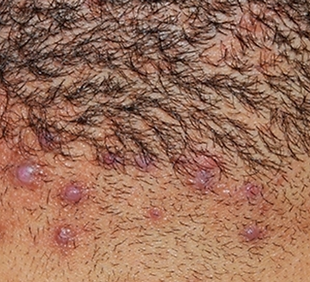
Acne keloidalis nuchae | Pseudofolliculitis barbae
Acne keloidalis nuchae is a chronic inflammation of the hair roots, accompanied by disfiguring scarring and local hair loss. Acne keloidalis mainly occurs in dark-skinned men, but can also occur in dark-skinned women and light-skinned men. The preferred locations are the chest, back, neck and neck, where it can occur in combination with ingrown frizzy hairs. Frizzy hairs tend to grow into the wall of the follicle opening, especially after shaving too close. The ingrown hairs cause inflammation and there is also a predisposition to keloid, which results in acne keloidalis.
.png)
Rosacea
Rosacea is a skin condition that shows some of the same symptoms as acne, but is not a form of acne. Think of inflamed bumps, redness and irritation, but these are not caused by clogged sebaceous glands, but by the demodex mite. With rosacea, the symptoms mainly occur on the cheeks and around the nose, as if you are blushing.
.png)
Yeast pimples
Yeast pimples are similar to acne but are a rash caused by the amount of yeast in the hair follicles. This inflames the hair follicle and causes itchy pimples. They often form in groups, are about the same size (like a pinhead) and itch, so you can tell them apart
of acne vulgaris.